Pipeline / Pipeline / system
Asset Ingest and Validation Pipeline
A data-driven ingest path for normalizing DCC exports, validating dependencies, and producing deterministic engine-ready packages.
Python · YAML · Git LFS · CI · Unity AssetPostprocessor
System shape
This page deliberately contains more system detail than a recruiter needs. It tests whether the framework can keep the overview compact while still giving an engineer enough information to understand ownership and failure handling.
Data flow
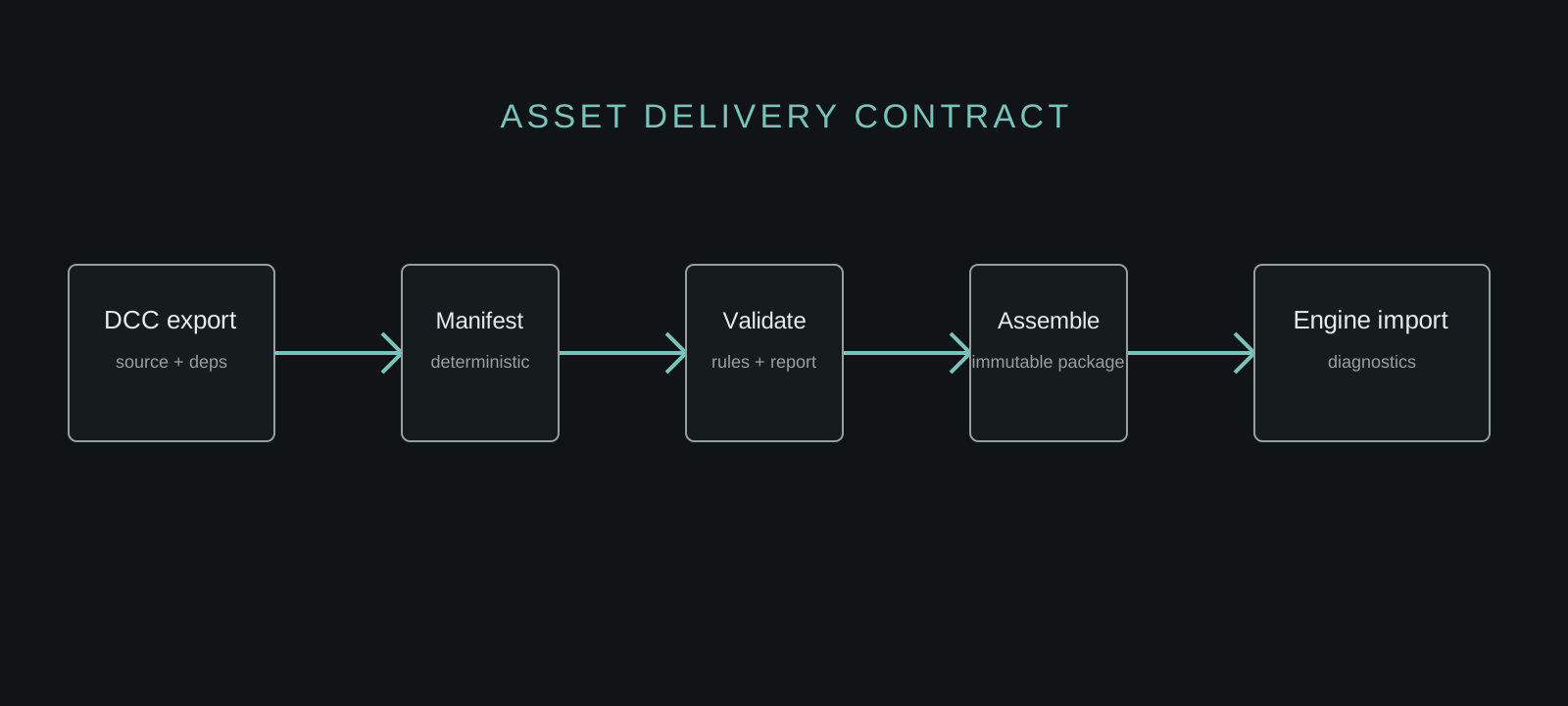
DCC export ? manifest generation ? dependency scan ? validation ? package assembly ? engine import ? report archive. Each stage emits a small artifact that can be inspected independently.
export.json
  source: assets/vehicle/body.blend
  content_hash: 7a9c...
  dependencies: [materials/paint.yaml, textures/body_basecolor.png]
  target: unity/vehicles/body
Failure handling
- A missing dependency stops the package before engine import.
- A recoverable naming issue is reported with a proposed rename.
- A package is immutable after assembly so the report matches the imported artifact.
- Build agents retain the manifest and validation summary for later comparison.
if not manifest.dependencies_complete:
    return Result.fail(
        code="DEPENDENCY_MISSING",
        owner="asset-author",
        retryable=False,
    )
Case study
Context
The production problem is not a single exporter bug. It is the accumulation of slightly different assumptions between departments and tools.
Case study
Constraints
- Existing artists keep their DCCs and local iteration speed.
- The engine importer cannot infer missing source intent.
- The system must support partial migration without a flag day.
- Every decision needs a useful failure message.
Case study
Ownership
I defined the manifest contract, the validation boundary, the error taxonomy, and the handoff documentation. The engine integration remained a separate ownership area with an explicit interface.
Case study
Scale
The design assumes thousands of assets, parallel build agents, and repeated re-imports during look development. Deterministic manifests are the anchor for comparing two runs.
Case study
Technical breakdown
The important technical choice is to keep normalization, validation, and package assembly separate. This lets a local artist run the first two stages without waiting for a full build, while CI repeats the same checks before delivery.
Case study
Results / impact
The system makes failure location visible and creates an auditable path from source file to engine package. The test page is intentionally text-heavy to challenge hierarchy and navigation.
Case study
Trade-offs
A manifest adds ceremony to small experiments. The pipeline therefore treats the manifest as lightweight metadata rather than requiring every personal prototype to pass through the production path.